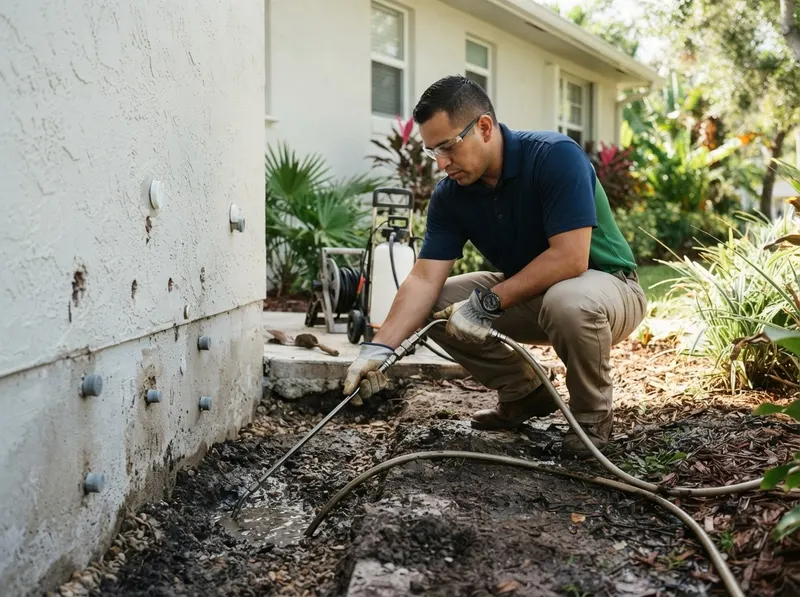
Subterranean termite soil barriers create an invisible, lethal transit zone around structural perimeters. Unlike older repellent chemistries that simply deflected insects toward unsealed foundation cracks, modern installations rely on advanced non-repellent agents registered through the U.S. Environmental Protection Agency. Foraging workers encounter the undetectable active ingredient while moving through treated soil particles, unknowingly carrying microscopic doses back to the subterranean nest. According to structural pest management documentation from the University of Florida IFAS Extension, this continuous horizontal and vertical saturation method stops subterranean tunneling before colonies reach floor joists, drywall paper, or subflooring. Because the chemistry operates entirely outside the residential envelope, indoor air quality remains unaffected, eliminating the need for indoor evacuation during subterranean exterior applications.
Soil barriers fit ground-contact masonry foundations, crawlspaces, and detached structures experiencing high external subterranean pressure. If a property features structural voids directly above grade without exterior soil access, localized baiting matrices monitored according to standards by the National Pest Management Association provide an alternative pathway. The practical trade-off centers on initial site disturbance versus treatment longevity: continuous liquid soil barriers require shallow perimeter trenching and intermittent drill holes through exterior concrete walkways, but they deliver structural defense lasting 5 to 10 years without requiring monthly interior visits.
Miami's subtropical environment presents unique installation variables. Highly porous limestone bedrock and sandy substrate mapped by the United States Geological Survey facilitate deep moisture retention, which accelerates colony expansion. In low-elevation waterfront pockets near Edgewater and Brickell, tidal intrusion and fluctuating coastal ground saturation monitored through the National Oceanic and Atmospheric Administration dictate specialized application depths to avoid chemical dilution. Historic homes with raised foundations near Coconut Grove and Coral Way often require continuous interior crawlspace rodding alongside exterior perimeter trenching to defend load-bearing piers. In urban residential corridors across Little Havana, Overtown, and Allapattah, zero-lot-line designs require specialized sub-slab injection needles that slide between pavers without destabilizing foundational pads.
Installation follows four defined technical stages. First, technicians excavate a continuous 6-inch by 6-inch trench immediately adjacent to the exterior foundation wall, conforming to technical label directions audited by the Florida Department of Agriculture and Consumer Services. Second, technicians pump non-repellent termiticide into the trench at a regulated rate of 4 gallons per 10 linear feet per foot of depth, utilizing pressurized subterranean injection rods calibrated under standards maintained by the Occupational Safety and Health Administration. Third, where paved patios or driveways touch exterior walls near Wynwood or Upper Eastside residences, technicians drill 1/2-inch vertical ports every 12 inches to inject the emulsion into underlying soil before sealing each opening with exterior-grade hydraulic cement verified via the ASTM International masonry specifications. Fourth, backfilled soil is mixed with the termiticide emulsion to create an impenetrable barrier that repels water wash-off under the rainfall patterns recorded by the National Weather Service. UrbanNest Pest Care conducts all operations with clinical precision, safeguarding your structural foundation without internal chemical intrusion.