Condominium Void Exclusion Miami
Multi-family residential towers across Brickell, Edgewater, and the Upper Eastside rely on continuous structural chaseways that run vertically through dozens of floors. These concealed voids distribute central air,…
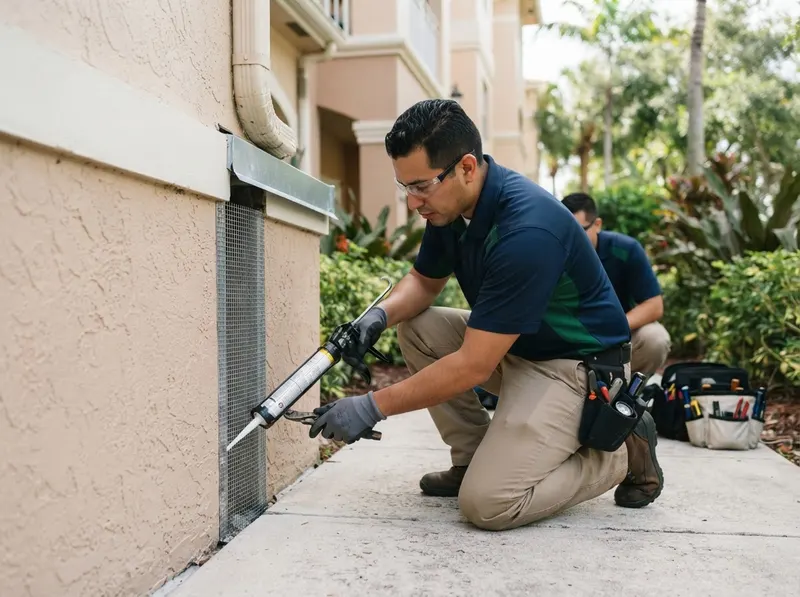
Multi-family residential towers across Brickell, Edgewater, and the Upper Eastside rely on continuous structural chaseways that run vertically through dozens of floors. These concealed voids distribute central air,…
Multi-family residential towers across Brickell, Edgewater, and the Upper Eastside rely on continuous structural chaseways that run vertically through dozens of floors. These concealed voids distribute central air, sanitary pipes, and domestic water supplies, but they also serve as migration corridors for American cockroaches, German cockroaches, and pharaoh ants escaping adjacent residences. The U.S. Department of Housing and Urban Development confirms that unsealed structural penetrations in multi-unit buildings defeat topical pest treatments by allowing target insects to simply relocate through interstitial drywall cavities. In subtropical coastal conditions, warm utility chases produce high relative humidity, attracting insects from ground-level mechanical areas toward residential suites.
Traditional pest management approaches rely on repeated chemical spraying over baseboards, but this practice does not intercept pests travelling behind concrete block walls or within ceiling plenums. Condominium void exclusion addresses the entry vectors directly by sealing structural gaps larger than 0.5 millimeters using elastomeric, pest-resistant compounds compliant with ASTM C920 elastomeric joint sealant specifications. Technicians isolate and seal plumbing lines beneath sinks, the sub-base of dishwasher recesses, and the perimeter around central air handler return plenums. In older residential properties located throughout Coral Way and Little Havana, settling can create irregular separations between drywall partitions and masonry boundary walls, requiring specialized woven wire barriers verified under NIST fire and building materials testing standards.
Selecting structural exclusion over recurring baseboard sprays protects indoor air quality by avoiding chemical suspensions within closed, air-conditioned living spaces. Homeowners in Coconut Grove high-rises and Wynwood loft buildings often face chemical sensitivities or wish to avoid contaminating sensitive fabrics, kitchen equipment, and nursery zones. Sealing mechanical penetrations provides durable separation from neighboring pest populations, though it requires access to hidden utility access panels and moving major kitchen appliances. The trade-off centers on upfront physical installation versus endless reactive sprays: physical containment stops ingress permanently, eliminating the need for recurring disruptive monthly chemical re-applications.
Technicians follow precise application methodologies aligned with EPA integrated pest management principles, ensuring all materials conform to strict safety boundaries. Sealing work around high-heat recessed halogen fixtures or electrical junction boxes follows NFPA 70 National Electrical Code clearances, while perimeter seals at floor slab boundaries utilize smoke-barrier materials meeting UL 1479 firestop containment ratings. This comprehensive approach isolates individual apartment units from shared building pest vectors, protecting structural health and resident peace of mind across all Miami-Dade communities.
Every job gets a firm, written price after a free on-site visit.
For standards, safe disposal, and service guidance on pest control services in Miami, FL, useful references include U.S. EPA, ENERGY STAR, U.S. Dept. of Energy, Consumer.gov, U.S. Census Bureau, and Google Maps. General consumer and small-business resources are available from USA.gov, Better Business Bureau, FTC Consumer Advice, U.S. Small Business Administration, and Ready.gov.
Tell us about your condominium void exclusion job in Miami and we'll send a clear, written quote, usually the same day.