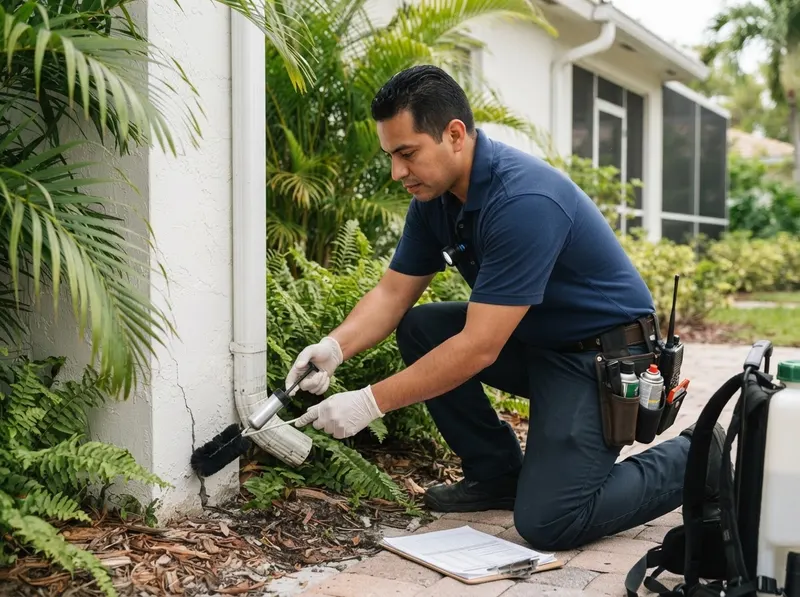
Ghost ants (Tapinoma melanocephalum) measure roughly 1.3 to 1.5 millimeters, presenting pale translucent abdomens that forage along kitchen counters, electrical faceplates, and plumbing chasms. In contrast, Florida carpenter ants (Camponotus floridanus) measure between 5 and 13 millimeters, nesting inside damp wood framing, insulation cavities, and structural roof sheathing. In coastal environments, high ambient humidity creates optimal nesting conditions inside wall cavities without requiring ground contact. According to the University of Florida IFAS Extension, conventional repellent aerosol sprays trigger an immediate survival mechanism known as budding, causing polygyne ghost ant supercolonies to fragment into 3 to 6 independent reproductive nests throughout neighboring wall partitions. UrbanNest Pest Care eliminates budding risks by deploying non-repellent micro-doses of fipronil and indoxacarb gel matrices certified under EPA pesticide standards, allowing worker ants to transfer slow-acting active ingredients directly to hidden queens over a 72-to-96-hour cycle.
Multi-family residential towers in Brickell and Edgewater feature shared utility risers, vertical plumbing chases, and drop-ceiling utility channels that permit rapid lateral migration between units. The Florida Department of Environmental Protection emphasizes structural source reduction over broadcast chemical applications to safeguard indoor air quality and coastal aquatic runoff. Technician assessments focus heavily on interior wet walls, sub-sink utility escutcheons, and unsealed conduit boxes along exterior balconies. Following non-repellent bait placement, technicians install cured silicone-polyurethane elastomeric sealants meeting ASTM International building material standards across pipe entries to prevent reinvasion from neighboring structural voids.
In mature, tree-canopied communities like Coconut Grove, Coral Way, and the Upper Eastside, carpenter ants establish primary parent colonies in decayed oaks or exterior landscape timbers, then bridge across physical branches to construct satellite colonies in attic rafters and window framing. Guidelines from the Florida Administrative Code Chapter 5E-14 regulate commercial structural pest control protocols, mandating strict perimeter assessments before chemical deployment. Field procedures isolate perimeter trails by trimming vegetation 2 to 3 feet away from rooflines, per the safety parameters established by the International Society of Arboriculture. Exterior foundation transitions receive localized liquid applications of chlorfenapyr, aligned with worker protection requirements from the Occupational Safety and Health Administration, intercepting structural foragers before they compromise framing timbers.
Historic wooden construction and dense single-family tracts in Little Havana, Allapattah, Little Haiti, and Overtown demand precise interior moisture identification. Carpenter ants do not consume cellulose like termites; they excavate galleries in wood softened by moisture leaks, leaving telltale accumulations of coarse sawdust frass. Structural protocols utilize non-destructive pinless moisture meters adhering to National Institute of Standards and Technology calibration standards to map subterranean and plumbing leaks around shower pans and roof valleys. Once moisture sources are recorded, technicians introduce dry boric acid dust deposits conforming to NIOSH chemical safety guidelines into hollow wall studs, preserving internal wood integrity without creating toxic residues or requiring multi-day resident evacuations.